


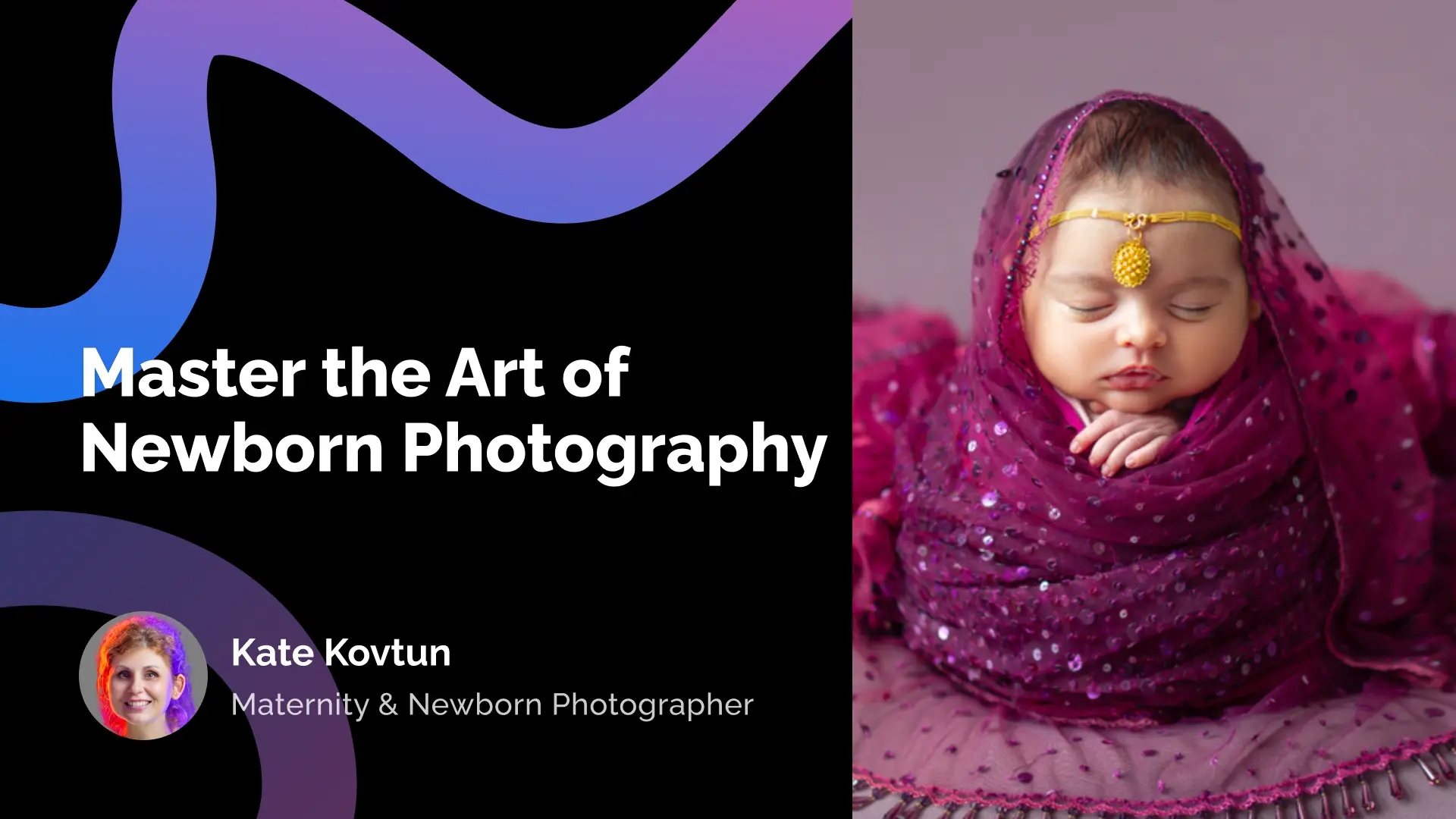
YouTube is full of newborn posing videos. But not many lessons that teach the things that actually matter: how to handle a baby safely, how to create calm when everything falls apart, how to work with parents who are exhausted and emotional. That’s what this article is about.
Kate Kovtun has specialized in newborn photography for 10 years, based in Malaysia, owner of KatePhotoKL. There’s no other photography genre where the stakes are quite this high — a fragile, wordless client, emotional parents, and images that will be looked at for decades. The technical side is learnable. The approach is what separates photographers who thrive from those who burn out.

Why This Genre Is Always in Demand
Kate puts it simply: babies are born every day. By 6 months, a newborn looks entirely different. These images are one-of-a-kind documents of a moment that cannot be recreated. That’s why demand doesn’t follow seasonal trends the way portrait work does.
But that same irreplaceability is what makes the work so serious. You can’t reshoot. You can’t reschedule after something goes wrong.
The Safety Rules That Can’t Be Negotiated
Before lighting, posing, or retouching — this is where every newborn session begins. Kate is direct: these aren’t guidelines. They’re non-negotiable.
- Never leave unattended — not for a second, even in deep sleep. Never on props without a hand nearby.
- No posing when awake or moving — a newborn can jerk suddenly. Always have an assistant or parent at 45° near the baby’s head.
- Head always supported — a newborn’s head is heavy relative to the body. No backward or sideways neck bends.
- Temperature control — if undressed or lightly clothed, turn off A/C, use warm air. Slightly warm is always better than cool.
- Hygiene is non-negotiable — wash hands before every session. Props and fabrics disinfected with UV lamp or steamer. Deep clean twice a year.

When Is the Right Age to Shoot?
The standard advice is days 5–14: baby is small, sleeps deeply, classic poses work well. Kate’s preferred window is different.
| STANDARD WINDOW: DAYS 5–14 – Baby is very small – Sleeps deeply, classic poses work – Skin may have puffiness or redness | KATE’S PREFERRED WINDOW: WEEKS 4–6 – Face defined and beautiful – Can look directly at camera (parents’ favorites) – Usually no baby acne or puffiness – Colic less frequent, calms quickly with swaddling |
The practical benefit: parents’ favorite shots are often the eyes-open ones. At 4–6 weeks, those are finally possible.
Lighting: Three Setups That Cover Everything
Kate works with natural light 90% of the time — large windows in her studio. With the right camera settings, the difference between natural and studio light is barely visible.
1. Classic portrait (45°) — the workhorse. Large umbrella (165–180 cm), at 45° to the face, slightly above eye level. Soft, even, virtually foolproof. Works for any session format.
2. Rim light — for drama and depth. Umbrella behind and to the side (1–2 o’clock position), dark background. Creates a beautiful contour rim — especially powerful for the bump in maternity sessions.
3. Backlight — for silhouette and glow. Umbrella directly behind the subject. Strong glow from behind, all focus on silhouette. Very artistic. Works beautifully with flowing fabrics.
Camera Settings
- Shutter: 1/200–1/250
- ISO: 100–1600 (can increase with natural light)
- Aperture: 1.2–1.4 for baby portrait; 2.2–3.5 for family shots

Working With a Crying Baby
Kate is matter-of-fact about this: babies cry. The difference between an experienced newborn photographer and a stressed one is having a toolkit.
- Swaddle first. Mimics the womb and calms most babies within minutes. Combine with gentle shushing and slow rocking.
- Warmth helps. A slightly warm blanket or heat pad under the posing surface.
- Feeding break. Never push through a hungry baby. 10 minutes now saves 40 minutes of struggling.
- Dim the room. Lower stimulus helps them settle if lights are agitating.
Retouching Newborn Skin
Newborn skin is both more sensitive and more forgiving than adult skin. There’s rarely complex texture correction needed — but redness, blotching, or milk spots benefit from gentle cleanup.
Kate uses the Retouch4me for newborn work because it handles skin cleanup without removing the delicate texture that makes baby skin look like baby skin. Key setting: everything at reduced intensity — often 50% or below. The goal is to make the skin glow, not to remove every trace of variation.
Our job isn’t to ‘fix’ the client — it’s to reveal their beauty. We smooth skin naturally and shift the focus to the eyes. We don’t erase someone’s skin — we help it glow.— Kate Kovtun
Gain more confidence for newborn & maternity shoots
We prepared two complete video guides with Kate to help you keep clients calm, babies safe, and results natural — from prep to final delivery:
- Safety + posing essentials (what to do / what to never do)
- Soft flattering light + simple gear that works every time
- Clean, natural retouching that makes skin perfect, yet real
→ Watch the free lessons: https://retouch4me-newborn-maternity.getresponsewebsite.com/